
IP65 vs IP67 for Outdoor Gate Locks: Reading the Rating Before It Reads You
An IP67 badge feels like the safest line on a specification. It is the higher number, it says “waterproof”, and it ends the conversation about weather. Twelve months later the lock on a coastal side gate has a fogged fingerprint window, a stiff bolt and a battery that lasted four months instead of twelve. The unit passed its ingress test. Nothing about that test predicted what actually happened.
Outdoor and gate installations are where smart door lock specifications get stretched furthest from the conditions they were written under. ENTRAVA has manufactured smart door locks for 11 years and keeps outdoor waterproof locks as a separate category, because the failure modes are not a slightly wetter version of an indoor door.
What the two digits actually say
IEC 60529 defines the IP code. The first digit covers solid particle protection; 6 means dust-tight. The second covers water:
- 5 — protection against water jets from a nozzle, under defined flow, pressure, distance and duration.
- 7 — protection against the effects of temporary immersion, commonly described as up to 1 m for 30 minutes under specified test conditions.
That is the whole definition. The rating says nothing about salt, UV, condensation, freeze–thaw cycling, driving rain at an angle, a pressure washer, or what happens when a sealed housing breathes through a temperature swing.
The first counterintuitive point: for a lock mounted on a gate, IP67 is frequently the wrong thing to optimise for. A door lock is almost never submerged. It is rained on, sun-heated, cooled at night, covered in salt aerosol near a coast, and occasionally hosed down by a cleaner. An IP67 housing that is sealed tight enough for immersion can actually trap moisture that enters through a cable pass-through or a battery cover, because there is no drainage path. The water that kills outdoor electronics usually arrives as condensation on the inside of a lens, not as a jet through a gasket.
Ask instead about the things the digit omits: operating temperature range, salt spray test evidence, UV stability of the touch panel, gasket ageing, drainage, and where the emergency port sits.
“IP65 front panel” is a different claim from “IP65 lock”
This is the single most important line to interrogate on an outdoor spec sheet. A great many products are described as “IP65 rated” when the rating applies to the exterior front panel only. That leaves outside the claim:
- the fingerprint window and its seal;
- the capacitive keypad membrane;
- the battery compartment cover and its gasket;
- the USB-C emergency power port;
- the cable pass-through between the two panels;
- the lock body inside the door edge;
- the interior/rear panel, which on a gate may also be exposed.
For an exposed gate, the rear panel faces the weather too. Some manufacturers explicitly rate both sides; others rate one. A sheet that says “IP65 front panel” is being accurate. A buyer who reads it as “the whole assembly is weatherproof” is not.
Put the question in the RFQ in plain terms: which subassemblies are covered by the ingress rating, and is there a test report for each? Then ask for the report, not the badge. A report names the standard, the test condition, the sample and the date. “Weatherproof” and “marine grade” name nothing.
The same discipline applies to corrosion. “Anti-rust”, “stainless hardware” and “coastal ready” are adjectives. A salt spray test report with a stated duration — 240 hours under ASTM B117 is a commonly cited benchmark — is a document. For a coastal or high-humidity project, ask which components were tested: the zinc alloy housing, the bolt, the strike, the screws, and the finish. A stainless bolt in a zinc housing with mild-steel fasteners will still produce the complaint photograph everyone recognises.
Temperature, batteries and the winter call-out
Outdoor spec sheets commonly quote an operating range such as −20 °C to +60 °C, occasionally wider. Two numbers hide behind that line.
The first is battery behaviour. Alkaline capacity falls in cold weather, and the motor draws a short high-current pulse on every throw — a working current in the hundreds of mA is normal, against a standby current measured in tens of µA. If the bolt binds because the gate has dropped or the strike is iced up, the motor stalls, retries, and consumes far more than the sheet’s estimate. This is why “12 months battery life” collapses to four on an exposed gate in winter. Ask what unlocks per day and what temperature the figure was calculated at.
The second is the charging or emergency-power temperature window, which is often narrower than the operating range. A USB-C power bank brought from a warm car to a −10 °C gate may not deliver what the label promises. Where the site sees freezing conditions, the practical answers are a sheltered position, a lock with a low-temperature battery chemistry, and a maintenance schedule that replaces cells before winter rather than after the first lockout.
Add three environmental details that no test chamber captures well:
- Sunload. A black panel in direct afternoon sun can exceed the quoted ambient maximum at its surface. Touch panels yellow, membranes lose sensitivity, and adhesives creep.
- Condensation cycles. Warm wet day, cold night, sealed housing. The moisture is already inside; an immersion rating does not help.
- Roof drip lines and gutters. A lock mounted directly below an edge that sheds water receives a concentrated stream, not ambient rain. Some manufacturers exclude this in their warranty terms for exactly that reason.
A rain hood or protective cover is a cheap, unglamorous component that often does more for field reliability than upgrading from IP65 to IP67. Where a product sheet offers an optional weather cover for extreme exposure, take it for gates without an overhang.
The emergency power port: position beats presence
Second counterintuitive point. Buyers check whether a lock has USB-C emergency power. Almost nobody asks where it is.
An emergency port is an opening in a weather-sealed housing. If it faces the weather on the exterior of an exposed gate, it is a path for water, dust, cleaning spray and salt aerosol — either through the port itself or through a rubber flap that will be torn off in year two. Some designs place it low on the exterior panel, where it also collects runoff.
A usable emergency path has three properties: it is reachable by the person locked out, it is on the less-exposed side or behind a properly sealed cover, and the procedure is written down. “Connect a 5 V power bank, wake the keypad, present the credential, then replace the batteries” belongs in the handover sheet. A port that is technically present but requires removing the lock from a gate is not an emergency path.
Also verify the fallback chain in order: low-battery warning on the device and in the app, mechanical key override or emergency power, and a battery compartment that can be opened without tools in the normal installed position. On a metal gate with the lock clamped between bars, that last item is worth checking on a sample unit before placing a bulk order.
Gate geometry is a different fitting problem
An outdoor gate is rarely a 40 mm timber door. It is a steel or aluminium frame, a flat bar, a mesh panel, or an old iron leaf with no preparation at all. That changes the mechanical family.
- Rim locks mount on the face and throw into a strike on the frame or post. They are the standard answer for metal gates because cutting a mortise pocket out of a narrow frame removes too much material.
- Mortise locks need a door thick enough to contain the body. Many outdoor-rated mortise models quote a wide thickness range — 40–110 mm appears on some sheets — and a minimum stile requirement around 96.5 mm. A slim aluminium gate frame will not meet it.
- Gate boxes / weld-on housings provide the pocket on a metal gate. Confirm who fabricates it: the gate contractor or the lock supplier. This is a classic scope gap on a project.
Then check the things that move after installation:
- Gate sag. A long leaf on two hinges drops at the latch edge. The same 2 mm that ruins a glass door bolt ruins a gate strike here, and the fix is hinge adjustment.
- Outward swing. An outward-opening gate exposes the exterior panel to weather that an inward-opening sheltered door never sees.
- Strike alignment under wind load. A gate that flexes pushes the bolt sideways.
- Sealing screw holes and cable pass-throughs after drilling. An IP-rated panel over an unsealed hole is not an IP-rated installation.
- Drainage. If water can enter the frame, it needs a path out.
Minimum stile width, door thickness range, backset (60 mm is common on mortise-based outdoor models) and swing direction should all be on the model-specific product pages rather than inferred from the category. The ETV-O2 page carries its own spec table; confirm the two separately, because outdoor SKUs in one family do not always share the same prep.
Warranty exclusions are part of the specification
Several manufacturers publish unusually candid warranty language for outdoor products, and it is worth reading as engineering data. Typical exclusions cover driving rain, hail, constant salt spray, flooding, immersion, water ingress beyond the stated IP level, and “normal ageing” such as colour fading, surface dulling or minor oxidation from UV and humidity. Some explicitly recommend a rain cover or a higher-rated model for extreme exposure.
That is not a supplier being difficult. It is an accurate description of what an ingress rating does not promise. For a distributor, the commercial question is whether the installation conditions in the target market fall inside the warranty or outside it. A product sold into a coastal region without the recommended cover will generate claims that are declined, and the decline will be correct.
This is where a brands and retailers programme should do more than translate a box. The local installation guide, the recommended accessory list and the warranty wording in the local language are what determine whether the first wet season becomes a support cost or a non-event. If the programme needs custom finishes, packaging or manual variants, raise it at OEM/ODM scoping — a rain hood designed for one gate geometry is a tooling item, not a catalogue add-on.
On compliance, keep the wording narrow: standards are adapted to the requirements of the target market where applicable. That is not a statement that CE, FCC, RoHS or ANSI/BHMA certificates are held for every model. Where a named report is a condition of handover, put the standard, version and the responsible party in the RFQ. Case studies and certificate packages are handled under NDA where that applies.
Outdoor project RFQ: the input list
| Input | Example of a usable answer |
| Gate / door construction | 60 welded steel swing gates, 40 × 40 mm frame, 2 mm wall |
| Leaf and swing | Outward opening, 1.1 m wide leaf, three hinges |
| Existing preparation | None / rim lock already fitted / 60 mm backset mortise pocket |
| Exposure | Fully exposed, coastal within 500 m, no overhang; −5 °C to +42 °C ambient |
| Mounting | Surface rim / gate box (state who fabricates) |
| Ingress scope required | Both panels + keypad + fingerprint window + battery cover + emergency port |
| Evidence requested | IP test report, 240 h salt spray report, temperature/humidity report, per SKU |
| Power | Battery type, standby current, assumed unlocks/day, emergency port location |
| Credentials | Fingerprint, PIN, RFID, app, mechanical override; user volume per gate |
| Connectivity | BLE only / Wi-Fi / gateway; signal survey at gate positions |
| Accessories | Rain hood, sealing kit, spare gaskets, strike shims |
| Volumes and timing | MOQ, sample approval window, phased delivery, spare parts allocation |
Send a photograph of the gate latch edge with a tape measure held against it. It tells a factory more about the bracket than three emails about “standard gate”.
The rating is a starting point, not the answer
Read an outdoor lock sheet in this order: which subassemblies the ingress rating covers; the temperature range and what happens at its edges; the corrosion evidence; the emergency power path and its position; the mechanical fit on the actual gate; and the warranty exclusions that describe the conditions the manufacturer considers out of scope.
None of that makes IP65 or IP67 irrelevant. It puts the digit back where it belongs — as one controlled laboratory result among several, and rarely the one that predicts the first service call. The outdoor category is organised around gate and exposed-entry applications for that reason.
If you are scoping a project rather than replacing a single unit, send the exposure conditions and the gate geometry with your quote request. The useful answer is a configuration with a cover, a bracket, a sealed emergency path and a maintenance plan — not a higher number printed on the same panel.
More field notes on installation and compatibility are in the blog.

Related Posts
-
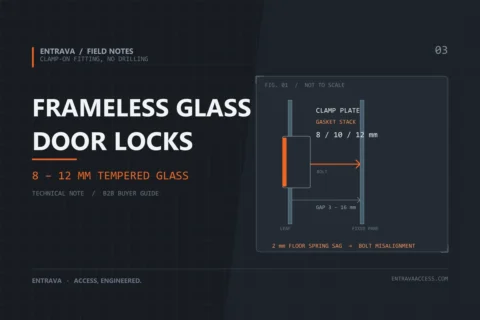
Smart Locks for Frameless Glass Doors: No-Drill Fitting, 8–12 mm Glass, and the Door Gap Nobody Measures
The glass is up, the partitions are signed off, and the client wants an electronic lock on the meeting room. Someone orders a “glass door smart …
-
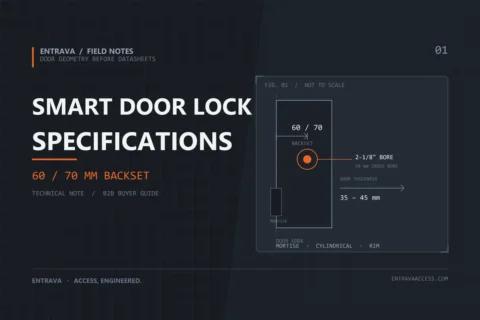
What a Smart Door Lock Specification Sheet Actually Tells You (and What It Quietly Leaves Out)
A two-page PDF arrives from a supplier. It lists a fingerprint sensor, six unlock methods, 4 × AA batteries, “12 months battery life”, an …
-
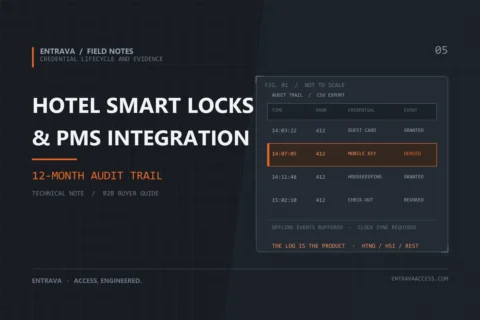
Hotel Smart Locks and PMS Integration: The Audit Trail Is the Product
Ask a hotel project buyer what they want from an electronic lock system and the answer is usually mobile key. Guests skip the front desk, the phone be…
-
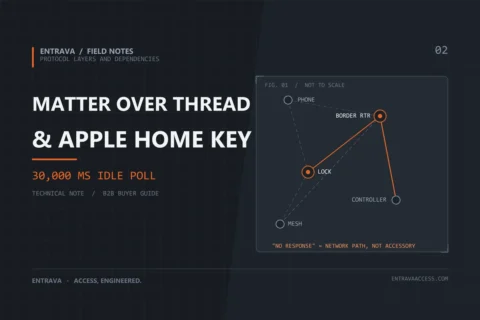
Matter over Thread, Apple Home Key and Aliro: What Actually Changes When You Specify a Smart Lock
Three badges on a box. One says Matter, one says Apple Home Key, one says Aliro. They sit next to each other, they are all about “compatibility&…