
What a Smart Door Lock Specification Sheet Actually Tells You (and What It Quietly Leaves Out)
A two-page PDF arrives from a supplier. It lists a fingerprint sensor, six unlock methods, 4 × AA batteries, “12 months battery life”, an IP65 badge and an ANSI Grade 2 line. It looks complete. Six weeks later the installer is standing in front of a 38 mm aluminium door with a 45 mm stile, holding a mortise body that needs 60 mm of backset and a door leaf thick enough to swallow it. Nothing on the PDF was false. The PDF simply answered questions nobody had asked yet.
This is the most common and least discussed failure in smart door lock sourcing. The product works. The door does not accept it. Returns, replacement lead time and a delayed handover follow, and the whole chain traces back to a specification sheet that described the lock in isolation rather than the lock installed in a specific opening.
The fix is not a longer spec sheet. It is reading the existing one in the right order: door first, mechanics second, electronics third, compliance last. ENTRAVA has spent 11 years manufacturing smart door locks, and the projects that go smoothly are almost always the ones where the door schedule arrived before the model number was chosen.
Start with the door, not the datasheet
Every field on a door fit checklist exists because someone once ordered the wrong configuration. Record these before you compare catalogues:
| Field | What to measure | Why it decides the model |
| Door material | Steel, aluminium, solid wood, hollow-core, uPVC, glass, composite | Determines what can be cut, clamped or sealed |
| Door thickness | At the lock body position, not at the edge | Interior panels have a fixed depth; rebated doors vary locally |
| Handing and swing | Left/right viewed from outside; inward/outward | Some exterior panels are handed; outward swing changes weather sealing |
| Backset | Door edge to centre of cylinder or spindle | 60 mm / 70 mm for European mortise; 2-3/8″ (60 mm) / 2-3/4″ (70 mm) for ANSI bored locks |
| Bore and edge bore | 2-1/8″ (54 mm) cross bore, 1″ (25.4 mm) latch bore in North American prep | A mortise lock will not drop into a bored cylindrical prep |
| Mortise pocket | Height, width, depth of the edge cut-out | Compare against the replacement body, not against the old brand’s name |
| Stile width | Face width available for the escutcheon | Slim aluminium frames often fall below 96.5 mm |
| Frame clearance and rebate | Gap when closed, rebate depth | A flush exterior panel needs room; the strike plate needs alignment |
| Exposure | Interior, sheltered exterior, exposed, coastal, high humidity | Sets the IP and corrosion requirement |
| Power and fallback | Battery access from inside, emergency path | A lock with no reachable battery door becomes a service call |
Two details here cause more change orders than everything else combined. First, measure thickness where the lock sits. A door that reads 40 mm at the edge can be 32 mm at a recessed panel or 55 mm around a frame rebate. Second, take photographs of both faces and the door edge. A caliper reading without a photo loses the information about the existing handle rose hole pattern, which is fixed per model and expensive to re-drill.
A digital caliper, a tape measure and a phone camera cost less than one return shipment. There is no reason to skip the survey.
Mortise, cylindrical and rim: three different promises
The word “smart lock” covers three mechanically incompatible families.
A mortise lock body sits inside a pocket cut into the door edge. It is the default across much of Europe and Asia, commonly paired with a lift-to-lock handle and a 60 mm or 70 mm backset, sometimes described by the centre distance between cylinder and spindle (the “68 mm pitch” or “72 mm pitch” you see on European sheets). It is strong, supports multi-point locking and gives the designer a long, slim escutcheon. It also needs a door thick enough to contain it.
A cylindrical or bored lock fits the 2-1/8″ cross bore and 1″ edge bore that North American doors are prepped for. Backset is adjustable on many latch bolts between 2-3/8″ and 2-3/4″. Retrofit projects in the US overwhelmingly land here, because the hole already exists and the installer only needs a screwdriver and a template.
A rim lock mounts on the door face and throws a bolt into a strike on the frame. It is the practical answer for metal gates, old iron doors and narrow frames where cutting a mortise pocket would remove too much material.
If a buyer sends an RFQ saying only “200 smart door locks, fingerprint, black”, the factory cannot choose between these three. It can only guess. That guess is where the six-week delay starts. When you send a quote request, the door type and prep are the two fields that turn a guess into a firm specification.
Backset, bore and the 2-1/8 inch assumption
North American prep is so standardised that it is often assumed rather than stated. A 2-1/8″ (54 mm) cross bore, a 1″ edge bore, and a latch with a 2-3/8″ or 2-3/4″ backset cover a large share of residential and light commercial doors. Add a door thickness range of 1-3/8″ to 1-3/4″ (roughly 35–45 mm) and you have the geometry behind most US retrofit smart locks.
The trouble appears when a project mixes door types: a timber main entry prepped to ANSI standard, aluminium-framed patio doors with a 45 mm stile, and a metal side gate with no prep at all. One catalogue model cannot cover all three. Specifying a single SKU across the whole schedule is a purchasing convenience that becomes an installation problem.
A second, quieter issue: some sheets quote the backset of the latch and others quote the backset of the lock body. They are not always the same number on a multi-point or mortise assembly. Ask which one is being quoted, and ask for a dimensioned drawing with the centre line marked. A dimensioned drawing settles in one email what three rounds of photos will not.
ANSI Grade is a mechanical grade, not an intelligence grade
ANSI/BHMA grading (Grade 1, 2, 3) describes mechanical performance: cycle counts, force resistance, bolt strength, finish durability. It says nothing about firmware quality, app stability, encryption implementation, OTA support or how long the manufacturer will patch a three-year-old model. An ANSI Grade 2 lock with an abandoned app is a worse purchase than a Grade 3 lock with a maintained firmware channel.
Here is the counterintuitive part: a higher grade is not automatically the better fit. Grade 1 hardware is generally heavier and its lock body is physically larger. On a 38 mm door with a narrow stile, or on a slim aluminium profile, that extra mass can be the reason it cannot be installed at all. Specifying “Grade 1 minimum” on a schedule full of narrow-frame doors is a reliable way to force a redesign of the doors.
Use the grade as a filter for the mechanical duty cycle the opening actually sees — a hotel corridor door and a rarely used plant room do not need the same rating — and evaluate the electronics on separate evidence: firmware release history, a stated support window, and a documented process for security issues.
“12 months battery life” is a calculation, not a specification
Battery claims are where spec sheets get closest to marketing. Ask what the number was calculated from.
The variables are concrete:
- Static current. Many locks sit at under 55 µA in standby; connected Wi-Fi models draw materially more because the radio stays associated.
- Motor current. A deadbolt throw can pull 250 mA or more for a fraction of a second, and a binding bolt can push that higher.
- Events per day. A residential door might see 8–10 unlocks. A shared office entrance or a serviced apartment can see 50–100. The same lock does not deliver the same 12 months in both.
- Transport. BLE-only locks are the low-power option. A Wi-Fi radio kept awake on a door will strip a set of AA cells far faster, which is why battery-powered Thread devices exist at all.
- Temperature and battery chemistry. Alkaline capacity falls in cold weather; a lock on an exposed gate in winter behaves differently from one in a heated lobby.
- Sensor load. Face recognition modules, always-on proximity sensing and backlit keypads all add draw.
So a “12 months” figure is usually shorthand for “12 months at N unlocks per day, at room temperature, over BLE, with a clean bolt”. Ask for N. Ask for the static current in µA and the working current in mA. Ask what happens at −20 °C. If the sheet cannot answer, treat the claim as an estimate, not a commitment.
Also check the fallback chain in order: low-battery warning (on-device and in-app), mechanical key override or emergency power contact, and whether the battery compartment can be reached without removing the lock from the door. An emergency USB-C or 9V jump-start port is only useful if a person can reach it while standing outside at 11 pm.
IP ratings: ask what the number actually covers
IEC 60529 defines the two digits. The first covers solids and dust (6 = dust-tight). The second covers water: 5 = water jets, 7 = temporary immersion under specified test conditions. That is all it defines.
The question that matters on a procurement call is not “is it IP65 or IP67” but “is the rating for the complete exterior assembly, or only the front panel?” Plenty of sheets say “IP65 front panel”. That leaves the fingerprint window, the keypad membrane, the battery cover, the emergency power port, the cable pass-through and the lock body in the door edge outside the claim. On an exposed gate, those are exactly the parts that fail.
Ask the same question about the test evidence. A salt spray test report with a stated duration (240 hours under ASTM B117 is a commonly cited benchmark) and a temperature/humidity test report are documents. “Anti-rust”, “weatherproof” and “marine grade” are adjectives. For a coastal project the report is the deliverable; the adjective is not.
There is a second boundary worth writing into the contract: IP ratings describe controlled test conditions, not every climate. Condensation inside a sealed housing, repeated freeze–thaw, driving rain under a roof drip line and UV ageing of a touch panel are outside what the digit promises. Several manufacturers say this plainly in their warranty exclusions. Read those exclusions before the order, not after the first complaint.
Certification wording is a trust signal in both directions
For export projects, the usual list is CE for the EEA, FCC for radio devices entering the US, RoHS for restricted substances, and ANSI/BHMA grading where a North American specification calls for it. Importers commonly ask for test reports, packing lists with HS codes, installation templates for the local door standard, and manual language variants. Those are reasonable requests and a factory should be able to answer them.
But there is a distinction that gets blurred in catalogue copy: compliance adapted to the requirements of a target market, where applicable, is not the same as holding a certificate for that market. A supplier that prints CE / FCC / RoHS / ANSI-BHMA across every model without naming the model, the standard version and the issuing body is making a claim that should be checked against documents. A supplier that states which reports exist, which are pending, and which are the buyer’s responsibility to obtain for a given SKU is giving you more usable information, even though the sentence sounds less impressive.
ENTRAVA’s own position follows that narrower wording: compliance is adapted to target-market requirements where applicable, and it does not imply that certificates are held for every model in every market. Ask for the report that applies to the exact SKU you are ordering. If a project needs a specific certification as a condition of handover, put it in the RFQ as a named requirement with the standard version, so it becomes a scope item rather than an assumption. Case studies, project references and certificate packages are handled under NDA where that applies.
Firmware lifecycle belongs in the hardware spec
A connected lock is a product with a software support window. Four questions belong in the same document as the backset:
- How long will this model receive firmware and security updates, and is that committed in writing?
- Are OTA updates staged and reversible, or does a failed update require a site visit?
- Is there an API/SDK and an integration guide for gateways, or is remote control locked to one vendor app?
- What happens to local credentials and schedules if the cloud service is discontinued?
For a distributor, the cost of a lock is not the unit price. It is the truck roll. A stable OTA path and remote diagnostics are worth more over a 500-door deployment than a marginally cheaper unit. This is also where OEM and ODM programmes diverge: firmware branding, credential rules and app behaviour are engineering scope, not a logo printed on the panel, and they need to be defined before tooling.
What to send a factory before asking for a price
A usable quote needs a usable input list. The following is the minimum that turns a catalogue price into a project price:
| Input | Example of a usable answer |
| Door schedule | Count by type: 120 timber entry (40 mm, ANSI bored), 30 aluminium slim stile (45 mm), 8 metal gates |
| Photos | Both faces + door edge + frame, per door type |
| Lock preparation | Existing backset, bore, mortise pocket dimensions, spindle centre distance |
| Credentials | Fingerprint, PIN, RFID (MIFARE 13.56 MHz or EM), mobile app, mechanical override |
| User volume | 10 users per residential unit vs 50–500 credentials per shared entrance |
| Connectivity | BLE only, Wi-Fi, Zigbee/Thread, gateway required, target app or platform |
| Target market | Country, applicable standards, required reports, language variants of manuals |
| Finish and branding | Matte black / satin chrome / PVD, logo method, packaging |
| Compliance | Named standards with versions; who obtains and who pays for testing |
| Volumes and timing | MOQ, sample approval window, phased delivery dates, spare parts allocation |
The solutions page for door manufacturers covers the case where the lock is specified at the door fabrication stage rather than retrofitted on site. That is the cheapest moment to resolve every dimension in the table above, because the door has not been cut yet.
Reading the sheet in the right order
None of this requires a more sophisticated supplier. It requires a different reading order. Door geometry first — thickness, backset, bore, stile, handing, exposure. Then mechanical family — mortise, cylindrical or rim. Then the electrical reality — static current, event rate, transport, temperature, fallback path. Then the evidence — dimensioned drawings, cycle test results, salt spray and temperature reports, firmware support window, and named compliance documents for the exact SKU.
The product range is organised by door application rather than by feature count for the same reason: a glass partition, an exposed gate and a US retrofit entry are three different engineering problems, and a spec sheet that treats them as one product with different colours will eventually cost someone a site visit.
If you are at the stage where a project schedule exists but the door survey does not, that is the point to pause. Send the door data with your quote request. The answer that comes back will be a specification you can install, not a list of features you can only admire.

Related Posts
-
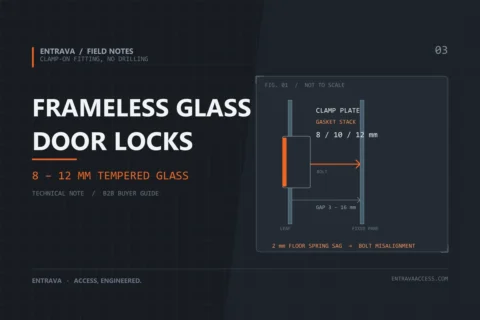
Smart Locks for Frameless Glass Doors: No-Drill Fitting, 8–12 mm Glass, and the Door Gap Nobody Measures
The glass is up, the partitions are signed off, and the client wants an electronic lock on the meeting room. Someone orders a “glass door smart …
-
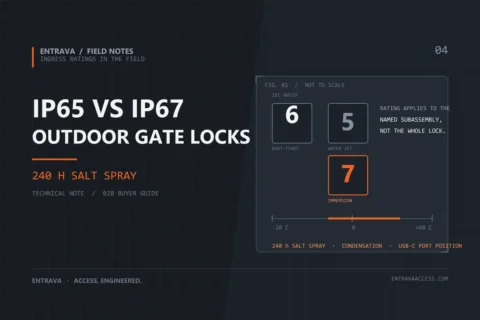
IP65 vs IP67 for Outdoor Gate Locks: Reading the Rating Before It Reads You
An IP67 badge feels like the safest line on a specification. It is the higher number, it says “waterproof”, and it ends the conversation a…
-
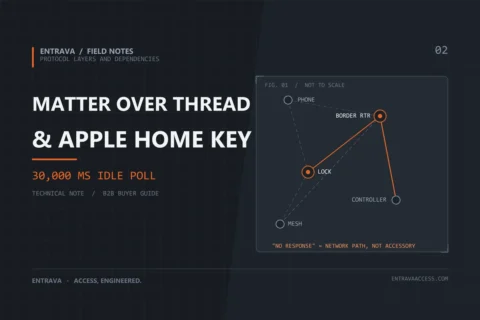
Matter over Thread, Apple Home Key and Aliro: What Actually Changes When You Specify a Smart Lock
Three badges on a box. One says Matter, one says Apple Home Key, one says Aliro. They sit next to each other, they are all about “compatibility&…
-
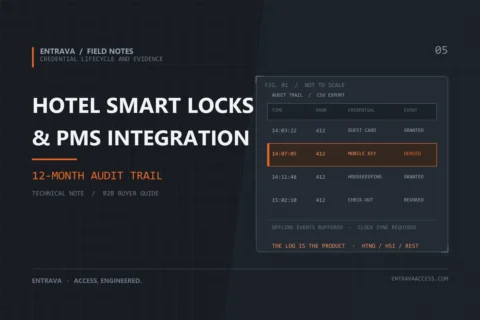
Hotel Smart Locks and PMS Integration: The Audit Trail Is the Product
Ask a hotel project buyer what they want from an electronic lock system and the answer is usually mobile key. Guests skip the front desk, the phone be…